
CN
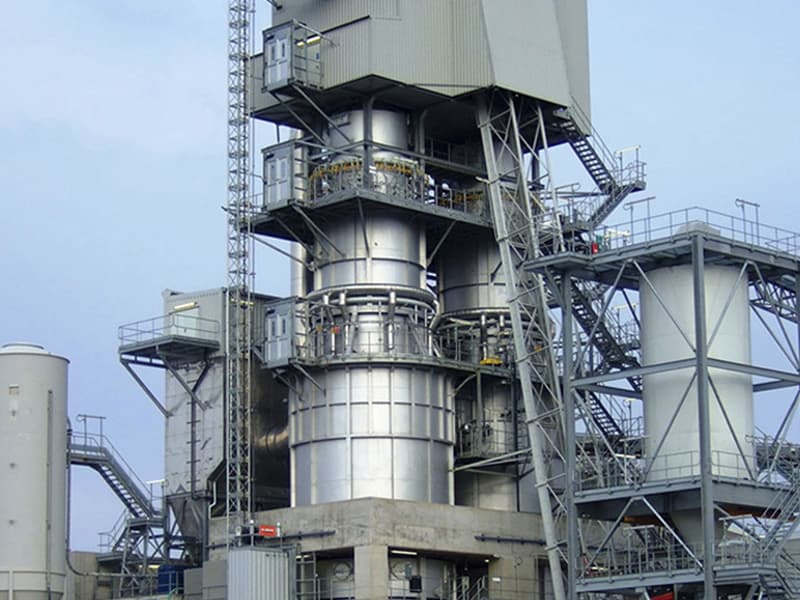
There are two types of shaft kilns used in our country: ordinary shaft kilns and mechanical shaft kilns. Lime shaft kiln, as the name suggests, is an upright kiln for firing lime.
Production capacity:
30-500t/hCalcination temperature:
1100±50°Fineness of finished product:
80μmR 12-15%There are two types of shaft kilns used in our country: ordinary shaft kilns and mechanical shaft kilns.
Ordinary shaft kiln is manual feeding and manual unloading or mechanical feeding, manual unloading; Mechanical shaft kiln is mechanical feeding and mechanical unloading. Mechanical shaft kiln is continuously operated, and its production, quality and labor productivity are higher than ordinary shaft kiln. According to the requirements of building materials technology policy, small cement plants apply mechanized shaft kilns to gradually replace ordinary shaft kilns.
Shaft kiln is also called shaft kiln.
The vertical mill drives the reducer through the motor and then drives the grinding disc to rotate, the material falls in the center of the grinding disc through the air lock feeder, and the hot air enters the mill through the air intake. With the rotation of the mill disk, the material moves to the edge of the mill disk under the action of centrifugal force, and is crushed by the grinding roller when it passes through the ring groove on the mill disk. The crushed material is carried by the high-speed air flow of the wind ring on the edge of the mill disk, and the large particles fall directly onto the mill disk for re-grinding. When the material in the air flow passes through the upper separator, under the action of the rotating rotor, the material is crushed. The coarse powder falls from the cone to the mill plate for re-grinding, and the qualified fine powder comes out of the mill with the air flow and is collected by the dust collection device, which is the product. The material containing moisture is dried in the contact process with the hot air flow. By adjusting the hot air temperature, the material with different humidity can meet the requirements and achieve the required product moisture. By adjusting the separator, the required thickness of different products can be achieved.
| Capacity(t/d) | 50 | 100 | 150 | 200 | 300 | 400 |
| Stock distributing device | BL-1 | BL-2 | BL-2 | BL-3 | BL-3 | BL-4V |
| Shaft kiln | 60m³ | 150m³ | 200m³ | 250m³ | 400m³ | 500m³ |
| Section form of kiln chamber | Roundness | |||||
| Disembark | WF-1 | WF-2 | WF-2 | WF-3 | WF-4 | WF-5 |
| Calcination temperature /℃ | 1100±50 | |||||
| Energy consumption index /(kCal/kg lime) | 950±50 | |||||
| Power consumption index /(kW·h/t lime) | 25±5 | |||||
| limestone : lime | 1.6~1.75:1 | |||||
| Lime burning rate /% | ≤13 | |||||
| Lime activity /ml | 220~280(It depends on the composition of the limestone) | |||||
| Ash discharge temperature /℃ | Ambient temperature +60 | |||||
| Limestone into the kiln granularity /mm | 30~80/80~120 | |||||
| Emission concentration /(mg/Nm3) | ≤30 | |||||
| Number of working days per year/day | ≥340 | |||||
| Overhaul cycle/year | 3~5 | |||||
| Number of operators/(person/shift) | 2 | |||||
| Suitable fuel | Massive anthracite, massive coke, massive petroleum coke, massive biomass fuel, etc | |||||